01
Your accounts stay yours.
Nothing moves to a platform you do not own. The colleagues work in the ad accounts, the CRM and the website you already have, so there is nothing to claim back later.
A retainer every month, a report a quarter later, and no honest way to tell which part of it paid for itself. The same work can run in your own accounts, with the reasoning in front of you before anything is spent.
How it runs now
With Firestarter
01
What arrives each month
An invoice, and a report a quarter later.
With FirestarterWork in your own accounts, and one page every Monday.
02
Who holds the plan
The agency, in a deck you do not own.
With FirestarterYou. Written against the target you set.
03
Changing course
On the next call, in a fortnight.
With FirestarterThe week it stops working, with the numbers under it.
04
What you keep if you stop
The reporting, if you ask for it.
With FirestarterThe accounts, the content, the data. All yours.
Three scenes out of a normal week. Nothing here runs before you have approved it.
01
Nothing moves to a platform you do not own. The colleagues work in the ad accounts, the CRM and the website you already have, so there is nothing to claim back later.
02
Not a quarterly deck. Every proposal names what it will do, what it costs and what it is based on, and it waits in one list until you approve it.
03
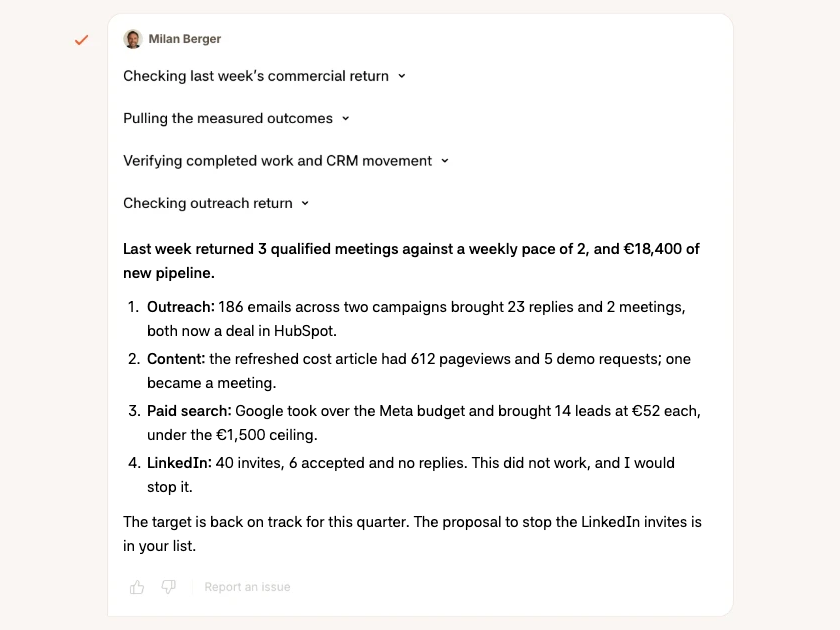
Milan reads back what last week's work actually returned, against your target. The review is not a presentation; it is one page, and it arrives whether the news is good or not.
 Felix LangPaid ads manager
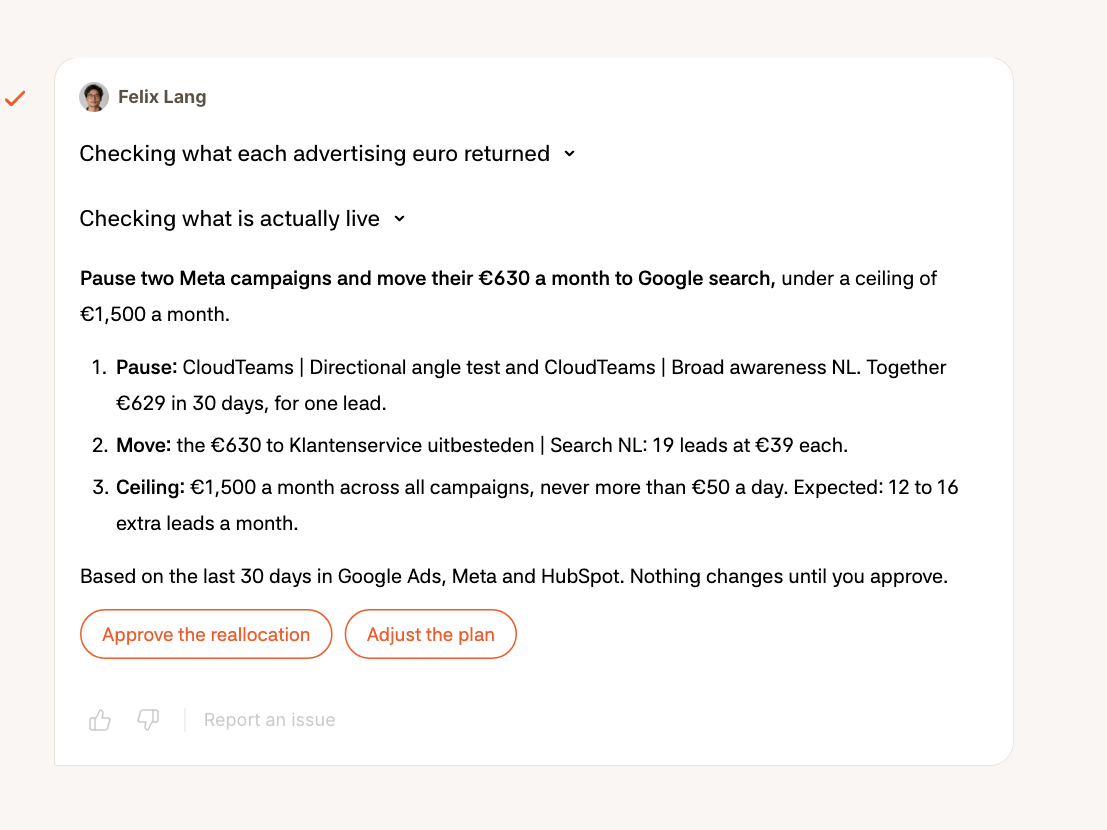
Felix Lang takes the part of the retainer that is easiest to check: the media spend. He reads every campaign against what it brings in, pauses what stopped paying back, and moves the budget to what converts, inside a ceiling you set.

Your own ad accounts. No new platform, and nothing to migrate.
No. Most customers start with the part that is easiest to measure, usually the spend, and keep the agency on what it does well.
It stays where it is. The colleagues work in your accounts and build on what already ranks and what already converts.
A colleague is €199 or €399 a month on a yearly contract, half that at the introduction price. Whether that is cheaper depends on your retainer; what changes for certain is that you can see what each part returns.
A named customer success manager who knows your account, and who sees what was proposed and what you approved.
Add Vera, Noor or Felix when the plan asks for them.